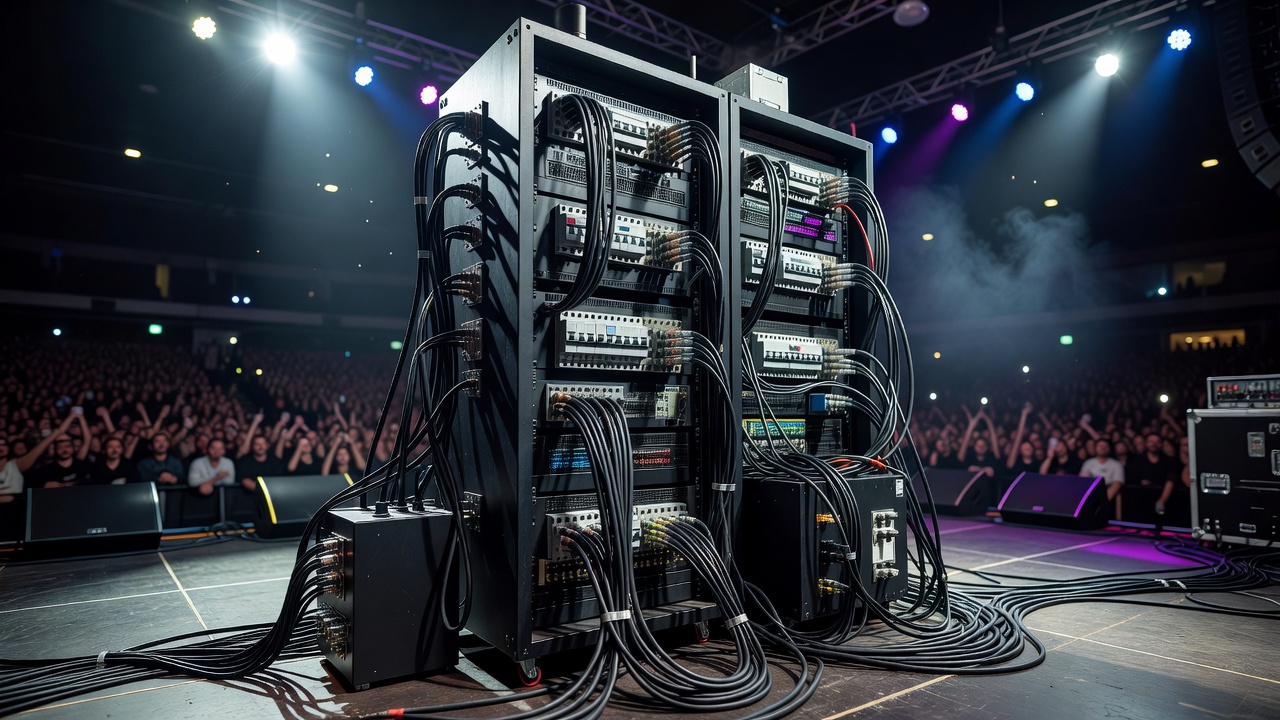
Managing dynamic electrical loads on multi-stage festival grounds presents unique technical challenges for master electricians and chief production riggers. As LED fixtures replace traditional tungsten sources, total current draw has decreased, but inrush current and harmonic distortions have introduced unprecedented complexities into three-phase power distribution networks.
1. Three-Phase Load Balancing Dynamics
In a standard 208V/120V or 400V/230V three-phase setup (L1, L2, L3, Neutral, and Earth Ground), maintaining balanced current distribution across all three legs is critical to prevent neutral wire overload. When high-power LED arrays with switch-mode power supplies (SMPS) operate, third-harmonic frequencies (triplen harmonics) aggregate on the neutral conductor.
If L1 carries 120A, L2 carries 115A, and L3 carries 40A due to uneven truss assignments, the resulting neutral current will generate extreme heat buildup. Overheated neutrals represent the single most common cause of electrical failure on temporary concert stages.
2. Inrush Current Mitigations & Breaker Curves
Modern automated moving head spots (such as the LuminaBeam 1000 MAX) utilize large internal capacitive banks. When main power distribution breakers are energized, the initial millisecond surge (inrush current) can exceed operational current draw by up to 15 times.
- Use Curve-D Circuit Breakers: Standard residential Curve-C breakers trip instantaneously under high capacitive load spikes. Curve-D thermal magnetic breakers tolerate brief inrush spikes without compromising overcurrent protection.
- Sequential Relay Power-Up: Configure smart power racks with timed relay sequences to energize lighting trusses in 3-second offset waves rather than firing the entire stage simultaneously.
3. Earth Grounding & Equipotential Bonding
Temporary metal structures, aluminum box trusses, and outdoor ground support towers must be continuously bonded back to the primary generator ground rod array. A maximum ground impedance of less than 5 Ohms must be measured using a certified earth clamp tester before connecting any power distros.
Furthermore, all audio shield grounds and DMX control lines must remain galvanically isolated from power line earths using opto-isolated splitters to prevent ground loops that induce audible buzz or control signal flicker during live broadcasts.